adeptability learns to publish, automate, and admit what it drops
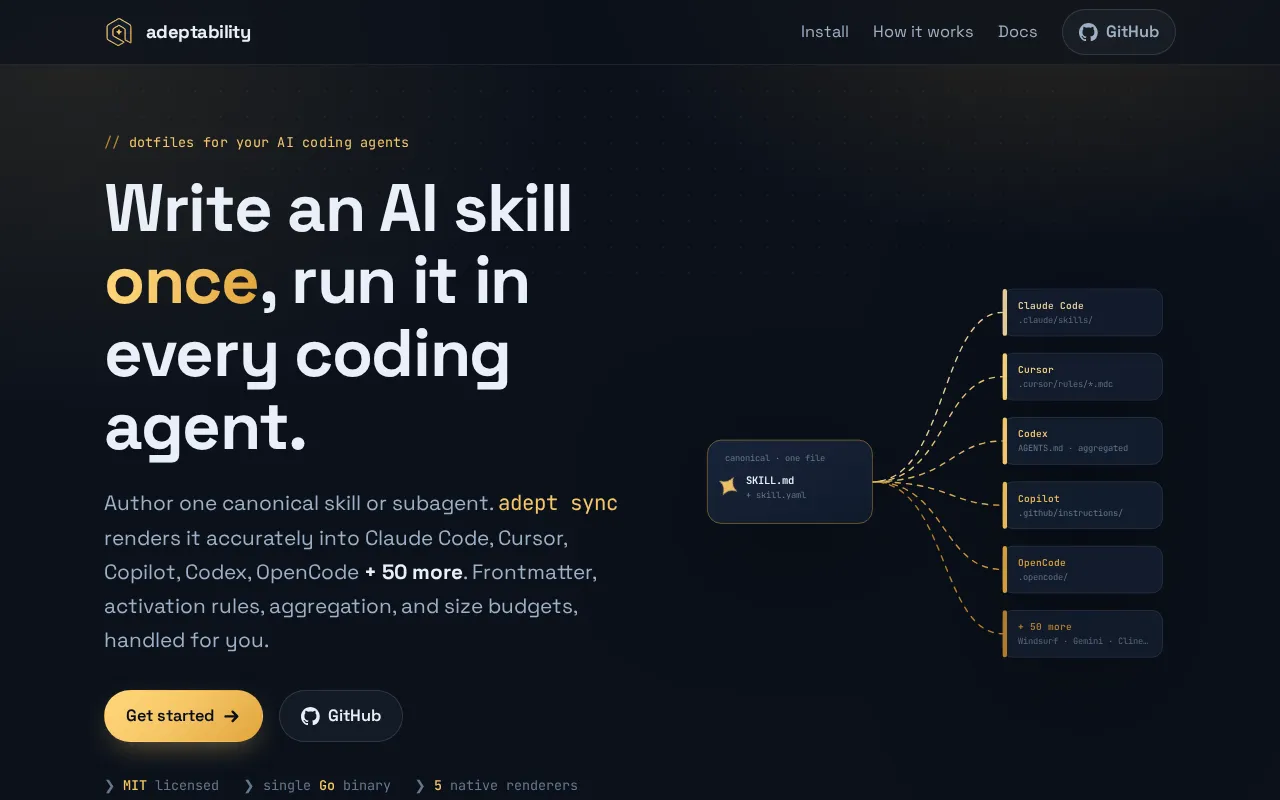
Since the last post, adeptability kept growing. Echo used it to consume shared skills. A month later we also publish them, automate around them, and trust it when a harness drops a file. Four threads carried that: publishable libraries, agents that compose into loops, honest rendering, and a scope split that keeps two things from sharing one directory.
Publishing a library, not only pulling one
The first post described consuming a library: commit a
{name, remote, ref} reference, and adept resolves it into a per-machine
store. It never covered who publishes that remote, which until 1.4 meant a
hand-rolled repo with no template.
adept init --as-library scaffolds a repo meant to be that remote, with
bundled library-management skills for the first contributor. A separate
bug had status lumping private skills into library-skill counts, hiding
the drift you need to spot; 1.4.1 fixed it. adept library update added a
workflow: fetch every library, show what changed, ask before applying.
adept library update                # check every library, prompt before applying
adept library update org-std --yes  # apply without prompting
Publishing a library was possible by hand. Now it is a command, not a README nobody reads.
Scaffolding agents instead of hand-writing them
The library already carried one hand-written PR-reviewer subagent. Scaling past it meant a template, and 1.7 shipped it.
adept agent add pr-reviewer --template evaluator scaffolds a canonical
subagent that renders into .claude/agents/, Cursor’s agents, Codex’s
.toml format, and the rest: the same author-once model as skills. adept agent check runs a safety scan and a best-practice lint before you trust
it with anything.
Loops got the same treatment: a discovery skill decides what to look at,
an evaluator agent that can say no, and a schedule triggers the round.
adept loop add stale-prs --workflow --edit scaffolds all three at once,
plus a GitHub Actions cron skeleton for unattended runs. It also prints a
first-loop checklist: state file, isolation, token cap, human review. A
loop with no evaluator and no cap is not automation. It is an unsupervised
script with better branding.
When a harness drops a file without saying so
Codex’s and Copilot’s renderers computed warnings when a skill’s sidecar
files, scripts/ or references/, could not survive that harness’s
format. Nobody read them: the warnings got built, then discarded before
adept sync printed anything. A skill with a scripts/ directory rendered
clean into Claude Code and silently lost the script in Codex.
A 1.6 fix wired those warnings into the sync summary and the JSON output. Losing a sidecar a harness format cannot represent is sometimes unavoidable; losing it silently is a bug.
Getting the binary onto every machine, properly
go install covers Go developers, not everyone else. 1.7 added a Nix
flake, so nix profile install github:itaywol/adeptability works without
that detour. 1.8 added completions everywhere the binary ships: Nix, the
goreleaser archives, the Homebrew formula. Cobra generated them at
runtime; packaging installs them.
Then the release pipeline broke itself: cosign v3 defaults to the sigstore
bundle format and refused to sign without --bundle, breaking the 1.8
release. The fix pins --use-signing-config=false --new-bundle-format=false,
keeping the .sig/.pem outputs install.sh verifies. A dependency bump
breaking the release signer made for a fun Saturday.
Proving it works instead of describing it

None of this shows up in a bullet list, so the README got a demo GIF: one
canonical skill, adept sync, rendered into Claude Code, Cursor, Codex,
and OpenCode in one recording. assets/demo.sh reproduces it exactly,
built with asciinema piped through agg: a real session replayed on
demand, not hand-edited marketing.
Two different things sharing one directory
This one had been there the whole time: skills lived in a per-machine
store, but libraries lived there too. One project’s adept library update
could yank a ref out from under a project counting on it to stay put.
1.9 splits the two. Libraries clone into .adeptability/libs/ inside the
project by default, .adeptability/.gitignore kept in sync automatically,
and adept migrate re-clones configured libraries from the machine store
into the project. The machine store still exists for skills: --global on
sync, status, and the rest of the CLI manages one skill set across
every project. Agent subcommands, loop add, and hook install stay
project-scope: a global agent or hook never made sense.
Current build is 1.9.0: install via go install, Homebrew, the curl
installer, or the Nix flake, listed in the
README. Docs
cover every command; the project page has the
design decisions, if the changelog is not enough.